No hour of life is wasted that is spent in the Wordpress saddle
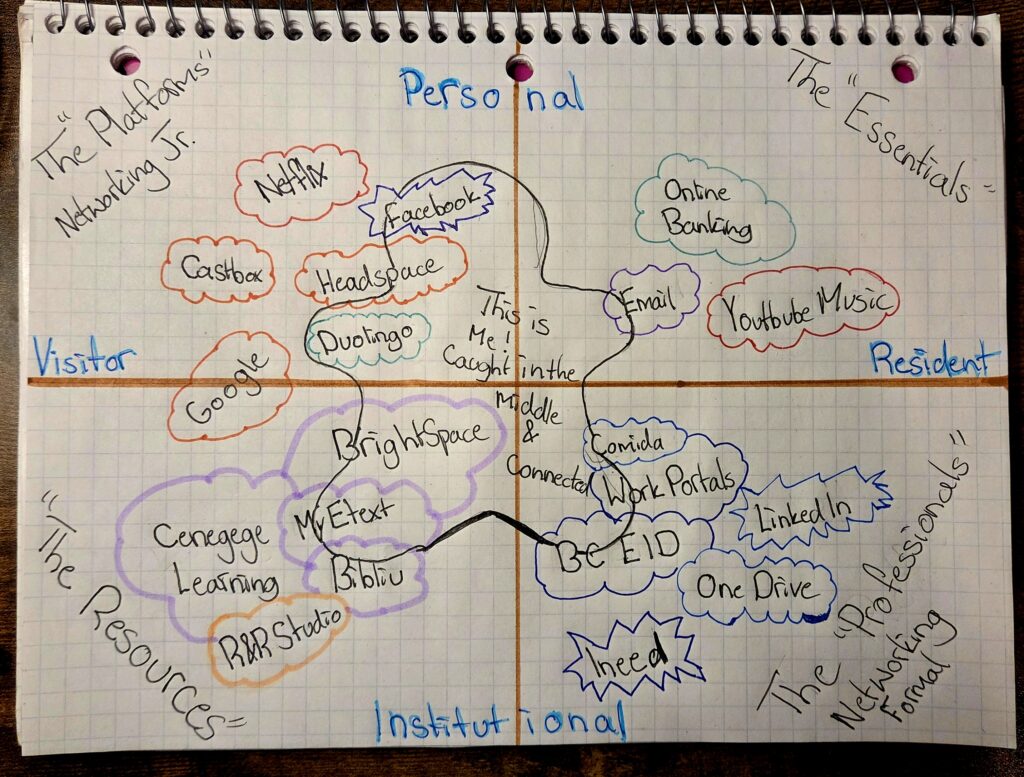
Visitor Residence Mapping: My Map of Digital Identity Versus Professional Identity
Above is my representation of my digital residence mapping, I drew myself in the middle, a relatable position that depending on the time of day varies but remains ever connected all the same.
Understanding the Importance of Digital Etiquette: Common Courtesy Online
When acting as a digital citizen we are faced with a multitude of online platforms and applications that we are expected to utilize and are known based on our recognizable activity on them. Whether we are surfing the web for answers on reddit, scrolling through our Instagram feeds, or reaching out to potential associates or employers on LinkedIn we as a society have come to a mutual understanding of the significance of our diplomacy and activity in the digital sphere. What we are willing to showcase online says a lot about the type of person we are and can curate preconceived notions about the type of human we may be like offline. Arguably with the increased amount of time humans are spending online connecting, relaxing and working, or studying we are inadvertently an extension of ourselves offline as we present ourselves online; the only difference is one is anecdotal information whereas digital identity comes with an extremely tangible reality of verifiable events being recorded with or without our strict consent. This fact becomes evidence enough to enjoy ourselves on the internet with social awareness and how I like to imagine it is that we are part of a party online. There are groups and cliques depending on the websites you frequent or the forums you communicate with most but ultimately you never know who is lurking around the corner or who may be taking a photo without your awareness. It’s not necessarily wrong or inherently bad to be seen but we always want to keep in mind that the internet is not the intimate family gathering we easily imagine it to be but rather it’s more like a staff Christmas party, at a large company, with a handful of acquaintances and a boatload of strangers you may or may not want to make a good impression on but you certainly don’t want to deeply offend as a first impression.
-But wait, I want freedom! An interlude, this is merely a suggestion, not an enforcement of law.
The way I am addressing this may seem daunting, and while there is something to be said about freedom of expression and not monitoring who we are and in return suppressing authenticity and originality it’s worth noting that nobody can stop you besides regulatory boards in extreme cases from deciding what you put online or who you allow to view it, but I am speaking from the point of view of the young, aspiring, hardworking professional or student who is trying to keep social awareness to a satisfactory level and ostracization from opportunities to a minimum. As always we can choose to enact our freewill and make those decisions which we know may harm our future selves online and often without real awareness of the implications in the moment. For these reasons I urge you to take a moment especially when posting something in a public and visible forum that may be used as a form of scrutiny and decide for yourself, and with yourself if there is a better way to say what you intend to and whether it needs to be said at all. If the answer is yes, I encourage the use of an alias if possible to limit the ease of tracing controversial comments or unorthodox opinions back to you in the future when you might wish you could take what you said back, and are unfortunately unable to do just that.
So wait, what digital platforms are students currently using to develop their professional network?
It’s important to address which platforms we as millennials and generation z’s alike are most engaged with to understand the perspective of this article. The 21st century Canadian students and adolescent professionals I have had contact with are most engaged with LinkedIn, Youtube and Instagram for things like “brand deals” and even applications like Snapchat have targeted young employees by online “Snaplications” which can curate a more efficient online only based resume and initial interview format for entry level jobs with are primarily employed through a younger demographic. These mediums may seem unfathomable for some older generations or possibly even certain parts of the world but for most westernized cultures there is a deep connection between your social media self and your employed self.
Brand deals and online work is just for professionals or influencers, right? Think again!
Not only is this a misunderstanding in the modern world between younger and older generations it’s also misrepresented. Though yes working strictly from home in the traditional view may be reserved for those with specific professions that allow for this there are a plethora of opportunities available for those who know how to market themselves. No longer are sponsorships or ambassadorships reliant on athletic status or career successes; learning how to play the marketing game and becoming the advertisement is the success. With each day we spend on social media there is progress and increased statistics about user demographics, engagement algorithms, and informative statistics that track what is most profitable for companies and businesses and targets them to direct subscribers, or adjacent viewers of accounts.
I get it- these ideas seem overwhelming and slightly exaggerated. Nevertheless, this is the reality our generation is faced with. The competition is fierce but the profits are appealing all the same. There is such a strong sense of dependency on devices especially in Westernized culture that a student’s life would be unrecognizable without it. This doesn’t mean we should necessarily say that having such a heavy reliance on the internet and social platforms is something that must be warded off but rather that it is a force we should learn to respect in all its beauty and power. Much like the forces of mother nature the media deserves to be enjoyed but it also expects us to be prepared to face it and embrace the unexpected. But just like it is impossible and unfulfilling to miss out on the natural world, we cannot move through our lives as professionals without embracing the new mediums of connection and networking via our digital reputation. Though it is something I personally struggle to embrace as I was born into a time where there was much debate about the benefits and consequences of online presence I think it would be naive to not acknowledge the many benefits my digital identity has had. There is much to concern ourselves with but if we treat ourselves with respect for our future and hold a modicum of decency for others our social awareness and innate desire to be good and approachable people should steer us in the right direction.
To Be or Not to Be Part of the Conversation? Rethinking When- and Whether- To Speak Up
Olivia Korbus
February 2026
As we’ve been going through this semester and engaging in a lot of contemplation and objective observations about ourselves and how we interact with media I’ve come to change my perspectives about social media slightly from being someone who very sternly stood in the mindset of being against social media and seeing it as a detriment to upon reflection someone who can be aware of and who has respect for the consequences that can come from social media but that will not necessarily always be detrimental. Not only socially from a wellbeing standpoint and the potential for networking through social media engagement which we discussed in our previous post but in the many ways social media can impact and shape our perspectives about the world as a whole. So let’s dive into this a little more.
I want to begin here by appreciating what Barack Obama had mentioned in his speech at Stanford where he spoke on the idea that our jobs as modern citizens and current world employees, parents, educators and every other member of this online community must act slowly and with ethical awareness of what they are contributing to the online space. There is a sort of dignity that we are to uphold our online habits as social media continues to reign as one of our main sources of information of the world and with content comes conversation; but in order to have productive conversations we must hone in on what is important to discuss in the first place.
Above is the video of former president Barack Obama cautioning us to be aware of misinformation during a speech at Stanford University
When we think about a PLN, the most overlooked element is the “learning” part. We rarely treat online spaces as educational, yet they are some of the most active learning environments we inhabit. We no longer rely solely on regulated newsrooms or professional broadcasters to shape public discourse. Interviews, commentary, and analysis now circulate through comments, blogs, reels, and posts. This openness has benefits, but as Clark and Aufderheide (2011) point out, it also creates limitations. Algorithms curate what we see, narrowing our exposure and reinforcing our interests. The abundance of perspectives can obscure facts just as easily as it can illuminate them. The result is a media landscape that is freer than ever, but also more fragmented and more susceptible to subtle forms of propaganda
So what do we learn from the dichotomy of printed press and scheduled network programming compared to the free spirited nature of social media and high speed internet? Well to me the take away on a grand scale and a personal use level is that where there is freedom there is also great responsibility. Like when we are engaging online as either a visitor or an active resident we have a decision to make and a standard to uphold. It’s one thing to justify sending a meme online or sharing links to a funny skit but it’s another to counterargue, comment publicly on a movement, sharing one’s personal opinions is a right but it’s also a privilege to be a part of the online community. Having a privacy protection clause is undoubtedly important and essential in the workplace, school forum boards, data bases of any kind; but, frankly we must first protect our dignity and our future selves before we act in a way we could regret once it’s too late. This is not intended to seem as intimidating as it might seem either, there’s a fine line between censorship and the right to remain silent if you will. Part of this ties into the course discussion surrounding allowing ourselves to be uncomfortable with another’s opinion before we react and moreover, realizing when it might make the most sense to choose to not act.
When analyzing the text from Moore & Schnellert (2016) the story regarding the students from the disability education center being encouraged to go to the pep rally for inclusion purposes despite their discomfort with the situation Moore & Schnellert (2016) outline well how it felt nearly as uncomfortable for the educator to not have the children attend the event as attending the event did to the students. This story spoke to me because it does relate so well to how we feel in the vast world of the social media sphere. We are faced with trying to be inclusive and defending everyone or standing up for someone because we feel like they are being taken out of context or like their content is being misunderstood or maybe we understood a political speech differently than what is being represented to us in the forum board or in the comments section and maybe our initial instinct is to go and rally on for what we believe is right, like the kids that we believe “should” be going to the pep rally. But maybe upon further analysis or taking a momentary hiatus from reactivity and choking the action on silence which grants you the opportunity to reflect is a much more sensible way to grow. We are all human, and that guarantees one thing, we will die and we will be wrong. In the process of the human lifespan all we can try to do is connect the best we can with those around us and the world we live in. In the spirit of fulfilling this destiny I hope we can all look inwards at our emotions and choose the most ethical course of action to be able to contribute to the dialogue with thoughtfully curated pieces of independent media in this vast new digital age Clark & Aufderheide (2011).
References:
Clark, J. & Aufderheide, P. (2011) A New Vision for Public Media: Open, Dynamic, and Participatory.
Obama, B. (2022). President Obama Addresses Disinformation [Video]. Stanford University
Moore, S. & Schnellert, L. (2016) One Without the Other: Stories of Unity Through Diversity & Inclusion. Portage & Main Press.
The Public PLN: What We Need to Consider to Be an Effective Consumer & Producer in The Media
Olivia Korbus
February, 2026
Risks and benefits of engaging with a public audience and the media space?
When analyzing what we could gain from being in the media as a public figure we can see how central it’s become to the identities of various professionals, from political figures, celebrities, activism groups and reports alike. With the expectation for digital presence and the shift from primarily in-person meetings or conferences as primary modes of connection to instantaneous digital information and disinformation we must approach contact with self awareness. In order to gain the benefits of such contact we must mitigate the potential for harm to ourselves and others. During the interview with experienced news anchor Sophie Lui, she mentions the significance of being online as a professional and as a person but not necessarily in a personal way. Lui mentions that there is a sort of quintessential aspect of understanding boundaries online for self preservation through understanding when and where it is appropriate to disclose what type of information and which types of opinions are shared in which spaces (Jesse Miller, 2026). It’s interesting for me to think of this concept because it metaphorically breaks the vast digital landscape into these more concrete chunks where even though certain information may overlap there is still a sort of inherent etiquette that belongs in a given space. Though it might not always be blatantly stated as Lui mentions there is a natural role we play when we are interacting in a public “intellectual” (Jesse Miller, 2026) conversation such as when we are asserting our views on a given topic of discussion in Twitter-like platforms for example. Though she continues to discuss that it’s not necessarily that her Twitter account is necessarily set to solely a professional account there is a natural rhythm in the conversation and the users she tends to engage with most are those who are involved in a more professional aspect of her life; though still connections I’d describe this as more of a distant acquaintance relation, or a colleague. It’s important the distinction Sophie Lui makes when she speaks in her more personal and residential platforms such as Instagram where there is a “different side of our personality” (Jesse Miller, 2026) shown, the more interpersonal and relational side of us. Though it is important to remain cordial it is less formal in its nature and thus the personal aspects of our lives such as our families, spouses, or vacations we take are able to reside without being outwardly out of place.
What could the risks be for someone in a position of power, an educator, or government official?
When analyzing potential risks for those in the public eye in regards to social media presence and having an extremely visible PLN a great point Sophie Lui mentions in regards to mistakes being more on display then ever before where though we have an opportunity to curate such a unique and perfected character online through the posts we chose to engage with or messages we send out into the world in the form of tweets for example there is simultaneously much less control of who witnesses the errors we may be unaware we’d made; such as through unintentional mistakes while livestreaming or reacting too hastily to a new story we hadn’t done enough research on (Jesse Miller, 2026). These situations curate a perfect storm for our characters to be taken out of reference of what we really intended to say and may disregard all the good we have done and nearly instantaneously dissolved the reputation we have tried to create for ourselves online. This happens with smaller scale individuals like when we see a family member or friend state an uninformed or distasteful opinion but when we’re not in the spotlight the same way a celebrity, or government official may be there is much greater opportunity for those words to be redistributed and even further perpetuated out of context for dramatic effect. Though it is important to recognize that these high status and very digitally visible individuals are too allowed to make mistakes for they are only human it also shows us the power of social media and the with the level of scrutiny our digital identity is under can be enough of a drive to teach us the value of retract before we react if you will. Basically what this idea is stating is that we are waiting to respond with emotions to a headline, new policy enforcement, or even a distasteful comment someone has left about us; though it might not feel the best in the moment this valuable skill has proven to allow us the debrief time needed for us to rationalize our response rather than spring into unplanned action and risk our reputation through doing so. When taking into account the visibility of celebrities and the amount of inauthentic information replication and inaccurate story telling done by the modern detectives or social media reporters I’d argue that there is a level of back-up approval required prior to submitting an opinion. While it is essential to do at least a basic level of research on a topic outside of what we have been presented with on social media stories while we are still in an age where the digital atmosphere of social media is a furious slew of those with misinformation, fake news, and a truth telling stories the ability to find a reputable source via this medium is challenging on a good day. The solution still is to go to a reputable source, learn how to find what a reputable source is and discuss things with those you trust prior to posting an opinion. In order to establish some credibility with our PLN we need to be a valid source of information to begin with.
Advantages of social media in the workplace?
I think it’s important we consider and appreciate the positives of social media because as we further discuss all that we should be cautious about it’s far too simple to begin disregarding the positives and begin feeling that all we worry about overshadows the positives but of course that’s not true, if it were I doubt social media would have taken such a gigantic overshadowing of all of information sharing to begin with. Firstly, the convenience Lui mentions the positives and the negatives of this in the section of the discussion where she speaks on how the work of a reporter varied significantly prior to having social media and smart phone access and how much more of an in person hustle it was (Jesse Miller, 2026) while I might admit it sounds much more entertaining and exciting to take on a job where I would be required to fly out of town to speak to those with an exciting story the province over, or take the time out of my day to meet with a business owner in person over coffee with a recorder in hand but we can’t deny the sheer amount of time “wasted” employers were covering. As the world increases speed and productivity expectations there is simply not enough time or resources to cover this type of work without the convenience of digitalization. Think about a life without email, or a pandemic without video conferencing, the world would be in a much different, and dire state compared to our operational levels of performance we are accustomed to in the digital age. Secondly, there is also a large impact of our PLN on employment opportunities and hiring where we are able to do a level one interview if you will based on someone’s online character. Through these platforms we can estimate someone’s level of conscientiousness, someone’s level of extroversion, and even some of their political and social standings. While these things could be seen as banal if we were just reading them off a page, when they are accompanied by the time we spend engaging with these types of content online and paired with how attached most people feel to their PLN spaces we can see just how vital and accurate this information actually is. We come to life with our digital identity and in this current age many if not all employers are doing a digital sweep of who someone is virtually prior to connecting with them in any physical way whatsoever. And lastly as Lui speaks to it there is just so much opportunity for personal growth and sharing of ideas in such an accessible medium. With social media rapidly working to overtake traditional media broadcasting there is denying that there is so much information being shared on these platforms that in order to “stay relevant” (Jesse Miller, 2026) we must be aware of. With so much of the conversation, politically, educationally, and socially occurring online in this space, shutting ourselves out of it entirely instead of allowing ourselves to be a part of these conversations is not helpful and will perpetuate isolation rather than allowing us to learn to connect and communicate in these new found ways; instead of finding ways to fight with social media and resist it (Hirst, 2018). I’d argue it is infinitely more valuable to attempt to understand it and spend our energy and resources optimizing how we can formulate relationships with others online but also how we can understand ourselves in a digital space.
So what is the value of being someone with media literacy & what is media literacy to begin with?
When thinking about media literacy it’s beneficial for me to compare it as an informational compass with radar beeps that are initiated when we’ve gone too far from the truth. We are often struck with media that we are daily certain is “fake news” or some form of propaganda but how so? Often like we saw in the (Media Smarts: Habilo Médias, 2021) there are no clear boundaries to an image that can tip us to the fact that something in fact is not real or is inaccurate information but being a citizen of the online community we are expected to be able to differentiate where a story originated form, whether there was a bias in how the story was told, and even weather an image or video was real at all or if it was AI generated or modified to fabricate the story. Another consideration we need to take into account is whether or not this content was generated with a satirical lens because ultimately the internet is not only used to share factual information but can often be used for entertainment as well. All of these factors are critical to take into account as far as being a media literate and informed user. Being able to implement the habit of fact checking and source investigation is required of us in order to be effectively credible and informed users of such platforms (Trilling, B., & Fadel, C. 2009). Some ways to ensure we are doing our best to be media literate users is through being able to utilize the internet for credibility of things we see on the internet if you will. Being a frequent fact checker on reputable websites such as Wikipedia, national geographic or well established medical journals or news broadcasting channels can be a good first step and learning to reverse search images for authenticity is another essential skill. In the (Media Smarts: Habilo Médias, 2021) they speaker mentioned a quick hack for identifying conspiracy theories and fabricated stories by simply surfing the web for the story you’re curious about and then adding “debunked” to the end of it; so simple and yet so effective. Of course for more nuanced fact checking it still might be best to visit a digital library resource or browse some credible textbooks, documentaries or other resources but for the majority of what we do in daily online interactions these simple strategies will prove themselves effective and will enhance our media literacy exponentially making us more effective digital users ( Trilling, B., & Fadel, C. 2009).
One final point I’d like to revisit is from the interview with Lui (Jesse Miller, 2018) where we talk about what we post online on which platform is determined by what the parameters and expected conversation/ interaction is done on these platforms. While it may seem innate to us in the modern day what we share where and when it is appropriate to do so, this too is a skill of digital media literacy. We ought to appreciate the ability to understand these methods of communication (Hirst, 2018) because without them we wouldn’t see the same social order we do online, these unspoken rules make up digital culture and allow us to have a common understanding that Twitter is an acceptable space to express more formally thought provoking opinions or the “intellectual side of [ourselves]” as Lui mentions it and that LinkedIn is not a space to post funny family updates but rather one where it is acceptable to boast about an academic or professional achievement without seeming overzealous and so forth
In summary…
These parameters are often undefined but are understood and seeing their pervasive nature inhabit our social habits and guide how we behave differently in these given platforms shows us just how powerful and alive these digital spaces really are. Being online is something we often try to run from but embracing how we run in them and how we can use them to better run our lives is an infinitely more relevant and useful way to spend our mental resources and energy.
References:
Jesse Miller. (2026, February 5). EDCI 338 – Week 5 – Blog 4. [YouTube] https://www.youtube.com/watch?v=oLFS_6KoCi0
MediaSmarts | HabiloMédias. (2021, October 15). What’s Real Online? | Media Literacy Lesson. [YouTube] https://www.youtube.com/watch?v=JQZfNCd-iwI
Trilling, B., & Fadel, C. (2009). Digital literacy skills: Info‑savvy, media‑fluent, tech‑tuned. In 21st century skills: Learning for life in our times. Jossey‑Bass. https://learning-oreilly-com.ezproxy.library.uvic.ca/library/view/21st-century-skills/9780470475386/fade_9780470475386_oeb_c04_r1.html
Hirst, M. (2018). Navigating Social Journalism: A Handbook for Media Literacy and Citizen Journalism (1st ed.). Routledge. https://doi-org.ezproxy.library.uvic.ca/10.4324/9781315401263
The Digitalization of Education
Olivia Korbus
March, 2026
The Expansion of Education:
As we move forward and expand our learning structure from a traditional instructor-led in person classroom to a dynamic lively interface which deals with interactions between students and instructors who swap knowledge, understanding, and roles of one another in the learning process with a level of fluidity that could impact the way students learn forever. Along with these shifts from the face to face to style learning to the online learning platforms we are constantly struck by a couple of main shifts for the education system. First we are faced with questions surrounding the platforms themselves, for example how does a digital classroom “exist” at all, and what does it mean to be “online together”? Next we are asked what this means for the teacher and the student when the dynamic between learner and instructor are blurred? We rely so heavily on these labels and losing them or at least changing their defined roles in education is threatening to the history we are so deeply attached to, in order to change our perspectives and titles we must define what makes them different. And lastly we are faced with the challenges of focusing the purpose of education being a process which derives greater knowledge as a group (part of the student becoming the teacher if you will) concept readdressed we need to understand the pressures and limitations this competitive individualistic standard can have and the hindrance it can have on collaborative learning and knowledge expansion.
So what the heck is a digital classroom,- also, why bother being in one?
A digital classroom example from (“Enhanced Learning Hub: AKRA TECH’s Online Classroom”)
When we think about being together online and imagine the natural pushback from those who argue online education as inferior to in person classrooms we need to outline why people might feel this way and what they might imagine a typical “students” journey to look like.
Through I haven’t run a poll which tells us exactly what an online school naysayer would argue I can wager it would improve something of a devoid, “anti-social” teenager or a busy adult student who doesn’t have any real time to dedicate to learning and so they take the “cop out” equivalent which requires no real tests, no real instruction or lecture, and no real learning really at all. Further we can picture the stereotypical student which is not interested in interacting with others and is looking to essentially further themselves from their learning by staying as far away from the instructor as possible However, I’d argue that while this visual narrative is persuasive it’s far from actuality, and here’s why.
When we investigate the average college student for example I’d safely say there’s a lot of students who care and are invested in the learning process and many which don’t, consequently we should expect a similar pattern with online learning. There is however an arguable difference in the accessibility and flexibility of online learning so perhaps for students with disabilities, familial responsibilities, financial or location difficulties there could be a significant increase in enrollment rates for online classes within these populations but that is not a bad things and by no means is it indicative of a less interested student!
When we imagine a “digital classroom”- there can be some confusion about its existence but if you’ve ever worked nearly anywhere in the 21st century, you’ve probably experienced something adjacent to an online classroom setting at the very least. But I am a psychology major and one thing I’ve learned these past 4 years is that people love a definition, so let’s make it more clear. To begin, a massive aspect of a great online learning space is in fact collaboration. We humans love to interact and connect with anything we can: peers, instructors, the course content or the interface itself. And this is exactly what a digital classroom provides. We are consistently interacting with visual and audio media, messaging classmates, interacting via zoom or participating in group work through a “wiki” (Laouris et al., 2010). The opportunities are endless, and honestly compared to my experience in the post secondary classroom these digital classes can be some of the most social arenas we may learn and work in. Even with connection being seemingly “forced” we are able to reach out to others with less hesitation than we might in a crowded class of 200 in between lectures and exams.
I can see it’s accessible, but what other benefits does online learning provide?
In the online atmosphere there is a natural skill of being your own teacher so to speak. There is a learning curve and a steep one at that which comes along with self guided learning. We are generally given parameters for learning online but there are also a great deal of conclusions which we must draw such as: here should I look for certain resources on this topic? Who can I connect with to help me discuss and better understand this content? What types of questions do I think I should expect and even how do I come up with my own questions that aid contemplation and further exploration of the discussed content? All these skills of learning are crucial in developing a well rounded and capable learner. There should be natural curiosity in education and there’s nothing better than taking education into our own hands to facilitate such creative quests for knowledge, a skill not often required in the traditional instructor-led, in person classroom we have been relying on for so long. We are taught self reliance online (Laouris et al., 2010) and for many this is a skill we will be expected to have going into the work force, we should be able to develop our skillsets of determining what appropriate lengths of study are required for us, learn to collaborate and interact with our peers and instructors when needed and become confident in our ability to pass on knowledge when we obtain it. Essentially this is the art of being able to think critically about our thinking and drawing of conclusions. Through the guidance of our instructors we are able to collaborate our conclusions and expand on ideas we have developed through self taught learning and ideally an instructor is there to guide these thought processes and expand our learning with us through understanding our interests, ideas, conclusions etc. which brings us to the next question regarding blurring the lines between “learners” and “instructors”.
What it means to be an instructor versus a learner:
When we think of the differentiation between instructor versus learner the first thing that I notice is the juxtaposition between between being a “good student” and an educator are seen as contrasting terms when really in order to be a relevant and effective educator we must first be curious as students and being a good teacher requires us to be inquisitive of that which interests the upcoming generations, and understanding how they communicate and what their passions are- without being interested in these nuances and remaining curious and helpful in assisting about what students are interested learning more about ultimately defeats the purpose of an educator and rather reduces to term to a figure head of education, someone that makes exams and maybe does a stale presentation claiming to be “shaping the minds of tomorrow” while letting their curiosity fizzle flat.
This type of education has been the standard for years but the revolution towards student-centered learning is the first step towards a required journey of change. We must continue to focus on inspiring the educator in order to reinspire the education system. Learners and humans are susceptible to the influence of passion and the experience of a learning journey which taking the instructor to a nuanced and relevant learner themselves reinvites the value into educational settings. There is a craft to determine how to steer students’ thoughts and conversations into inquisitions and research driven answers and professors should be alongside students deciding how to factor in these questions to curriculum goals, required materials and other formal aspects which establish the learning students must achieve by the end of the course.
The quote from (Laouris et al., 2010) “An interdependent group is one in which the learning outcomes of its members are linked: in a truly cooperative interdependent group, no one can succeed unless everyone succeeds” encapsulates this point so gracefully and logically.We humans go to school because we learn best from other humans, our teachers. But when we look at it further we can learn even deeper through discussion posts and connection based communities having the ability to pose questions, thoughts, and work on projects as our ideas come to mind can perhaps allow us to learn not only from one source but can help us understand how to better collaborate in inclusive ways where students and instructors alike can enhance the education system through this new model.
Balancing the Professional with the Personal:
A large issue that many think of when it comes to instructors taking part in digital communication with students and how we can professionally navigate this relationship in an ethical manner. There are many social media regulations that come alongside being a professional online as well as in the classroom, and with those two ideas becoming one in the context of digital classrooms so should the expectations we hold ourselves and professionals to in regards to what is appropriate etiquette with students and colleagues online. There has always been a standard and there will continue to be a standard of behaviour. In fact with the modern awareness of digital identities there needs to be increasing awareness of the traceability and potential consequences of not taking our online activity seriously because as working and learning online becomes more commonplace so does the impact of our online footprint on our professional identities all together. There is less of a differentiation between communicating digitally and just communicating as (Dyer, 2016) mentions and to pretend these changes aren’t real or important is not only isolating us from taking part in the massive online community of conversation but it is also hindering our abilities to be effective educators who can guide learners into being effective users of the online world or really just the world.
We are called to address the ethical necessity of learning to interact safely and effectively with vulnerable individuals who might either be in the care of others or may require someone to sign off on a waiver for example allowing for their participation in a an online community and therefore awareness and training to familiarize yourself with the vulnerable sector we as individual professionals may face is of the utmost importance and precaution when discussing how to operate effectively in an online learning community.
Final words:
When analyzing these questions I can reflect on our experience in EDCI 338 shows how a collaborative online environment even though it is initially unfamiliar and even disorienting it can become a space where shared curiosity, accumulated educational experience, and genuine social connection reshape how we learn. By engaging with one another’s blogs, interpreting diverse sources, and co‑constructing criteria for our own learning, we’ve created a classroom that blends the digital and the analog, the personal and the collective. In doing so, we push back against competitive norms that have long shaped formal education and return to something far more natural: learning through communication, cooperation, and community.
References:
Laouris, Y., Underwood, G., Laouri, R., & Christakis, A. (2010). 8 Structured Dialogue Embedded within Emerging Technologies. Emerging Technologies in Distance Education, 153–174. https://doi.org/10.15215/aupress/9781897425763.009
Dyer, H. (2016). Incorporating & accounting for Social Media in Education | Harry Dyer | TEDxNorwichED [YouTube Video]. In YouTube. https://www.youtube.com/watch?v=ZteEZbAtsNI
Gaining Perspective Surrounding PLNs
Olivia Korbus
When reflecting on whether my PLN usage and interaction has changed throughout the course, I have noticed some behavioural shifts I’ve experienced but I certainly have adapted my mentality and understanding of the significance of PLNs in our world.
One shift I have noticed for myself in recognizing how impactful our digital perception can be is how I interact or don’t interact with others online. When I say this, I am coming from the perspective of someone who has a lot of resistance to using the internet to communicate with others. Possibly from how I grew up culturally from an Eastern European family there is a large emphasis of digital communication being used for the news, and contacting family in distant places, not those you are close to who you could spend time interacting with in person instead. Though I don’t disagree with all this information there is also a seclusion that one experiences when trying to resist adopting how much of the world connects. Learning to adapt to these differences in how we communicate virtually versus a typical offline traditional form of contact has taught me the importance of expanding my digital social circle to better participate in the online world and joining the conversation as Harry Dryer puts it.
Additionally, when thinking about digitalization in the workplace and throughout the education system we need to adopt and take the time to grow our digital literacy so we can participate effectively and appropriately in wiki spaces for example where much of modern-day learning and collaboration exists). As well there is a learning curve even in courses like we are enrolled in, EDCI 338 where the platform used for coursework is varied and there are a certain protocol and format of communication, we rely on with fellow classmates, lecture materials and instructor contact. These changes might be initially overwhelming to adapt to but, online learning and communication is something humans are innately designed to do which is adapt and learn to partake effectively in multimodal methods of correspondence.
How my communication has changed is understanding the value of responsiveness. At work for example I am expected to be prompt with communication regarding emails, upcoming shifts, staff meeting attendance etc. When it comes to my personal life I struggled with this a lot more. There was always a thought in my mind that the communication was “less real” than if someone were to directly call me or pass me by at school. However, I’ve realized that as a society we are deeply identified with our online persona according to Trilling & Fadel, 2009 we are entrenched in the reputation we have as “communicative and responsive” or someone who is resistant to being part of this form of contact. I recognize that people are often impacted by online behaviour in similar ways they are impacted with in-person interactions because for many there is a significant amount of time spent in the digital sphere and someone’s lack of effort to respond is noticed. This has influenced me to become diligent in the timeliness of my responses and awareness that others may be paying a lot more attention to my presence or lack thereof online says Sophie Lui.
This new perspective has led me to think more seriously about curating a warm and professional online persona. This would allow future employers who may analyse me as a candidate for a job where I’d be more directly involved in digital communications as Sophie Lui discusses as a form of evidence of my digital literacy. This is an asset which showcases confidence in curating and utilizing technology appropriately for networking or collaboration. In the modern age it’s as though our online presence is a portfolio of our professionalism and experience and while I am still putting mine together, I’m glad I started the process when I did.
Citations:
Hermida, A. (2015): why we share & why it matters. Doubleday Canada.
Laouris, Y., Underwood, G., Laouri, R., & Christakis, A. (2010). 8 Structured Dialogue Embedded within Emerging Technologies. Emerging Technologies in Distance Education, 153–174. https://doi.org/10.15215/aupress/9781897425763.009
Dyer, H. (2016). Incorporating & accounting for Social Media in Education | Harry Dyer | TEDxNorwichED [YouTube Video]. [YouTube.] https://www.youtube.com/watch?v=ZteEZbAtsNI
Learning in an AI-Driven World: The Benefits Beyond the Anxiety
Introduction: The Anxiety of AI- is it all we are told to worry about?
As the online possibilities for learning, growth and creation blossom so do the concerns surrounding these very abilities. Professionals, parents, and overwhelmed students alike are questioning the appropriate integration of Generative-AI (GenAI) and online learning networks. We live in a world bombarded by expectations and warning labels. I’d argue that both PLNs and AI can enhance equity, accessibility, and professional growth but only when educators and students develop strong AI literacy and intentionally integrate these tools into learning. The newest generations of learners are being told that they are losing abilities to think and function creatively without artificial creations but yet they are also being told that they are able to “achieve anything” especially with the implementation of GenAI. Setting them up to fail through saying they SHOULD be able to achieve anything with AI but they’re not going to because they were raised on AI reliance. This sort of oxymoron is seemingly confusing but harmless overall until we actually look at the effects we face when learning to operate in this world of high expectations with low potential for individual student success.
My Personal Experience: The increased pressures for originality and the shift in student life
As a student myself I have seen the shift of late night procrastination sessions and students collaborating on trying to find answers for assignments; to AI based article searches and paper outline suggestions and revised notes/practice tests created with Generative AI. Though this might seem like a positive change in regards to productivity; I would argue it is a double edged-sword as we face a time where authenticity is questioned in papers and professors need to try and arrange coursework in a way that balances work that could be done with assistance of AI searches but also a level of originality which will need to be more nuanced and niche in responses to ensure authenticity. Inadvertently this creates an increased level of pressure to use AI to create higher quality work especially when they’ve been told they are less capable than previous generations to perform at such a high level of creative thinking. But does that mean all students and teachers are doomed to trying to navigate these cycles of inadequacy and overreliance on AI in learning? How about the assistance of PLNs, will they also lead us further into this cycle of doom? Not necessarily, as we can see others are already looking for solutions.
We Need to Increase AI and Technological Literacy
When we think of how we can more effectively navigate this type of learning conundrum an essential aspect to growing with technology is assisting teachers in understanding the limitations and ethical methods of incorporation of generative AI and how we can approach it in a way that enhances the learning experience and benefits our creative instincts by assisting students to utilize AI when appropriate produce outcomes that might have taken more time than they have to create but requires collaboration and the basis of ideas such as papers or online short films as projects for example but leaves the labour section to the Generative model. Arguably, yes there are some skills being lost through this “reliance” but this is simply convenience and when I think of ethical AI use and developing a well rounded learning experience online, experimenting with these development tools and implementing creative production with these new systems is enhancing the learning experience instead of hindering it.
Also it is essential for teachers to receive adequate training on the possibilities PLN’s provide as they continue to prevail in our education system and professional employment scenarios. Limiting students’ preparation and possibilities for learning in a variety of mediums is unacceptable in the current digital age. Also the education system would be naive to believe that using traditional non-digitalized learning is the only way to keep critical creative thinking skills well honed. As Estaiteyeh and Mindzak (2025) puts it “AI literacy [and digital literacy all together] is likely no longer just an addendum to teacher preparation, but instead a more critical dimension of professional competence of new teachers.”
AI: Equity and Accessibility- How these concepts really align
When we think of the equity aspect of social media use and the influence of AI on education and personal learning network growth we are forced to acknowledge the benefits it creates for leveling the playing field especially for those who would struggle to network or access additional academic support without affordable and relatively easy to access online platforms. Undeniably there is a benefit to being able to connect on a digital platform with potential employers or with professors you might struggle to meet outside of traditional office hours this accessibility amplifies when we think of disenfranchised folks who are now able to be seen on an online platform with their own curated display of personalized values and accomplishments such a LinkedIn profile or social media based blog which highlights personal abilities and interests. As well we must acknowledge the positive impact that AI can have on learners who may be unable to access additional academic support such as tutoring or for those operating with a language barrier who are able to quickly access and benefit from academic assistance in these aspects. Whether being able to translate or explain topics in a step-by-step fashion for students struggling to understand challenging concepts,students who struggle with write cohesively or for those feeling stuck on mathematical problems- learning how to use these devices productively has potential to be massively beneficial anyone seeking support in a low-barrier low-cost manner.
What the literature says:
As Chang et al., (2023) notes “Rather than attempting to suppress using AI in education, educators should proactively seek and explore ways to adapt its presence.” and that seems to be a common theme in those who are seeking positives in the use of AI versus trying to simply eradicate it and ignore its positives, but how can educators and the education system alike work together to establish better grounds for students to derive these positive impacts? Change et al., (2023) have some further thoughts
“ This adaptation can be effectively achieved by establishing fruitful collaborations between educators, instructional designers, and researchers in the AI field. Such partnerships should strive to explore the integration of pedagogical principles within AI platforms, ensuring that students not only derive benefits from AI but also acquire the essential skills mandated by the educational curriculum.”
This shift in understanding that educators not only need to learn how to tame the overreliance on AI but rather actually recognize how students could learn better through AI implementation in the fabric of curricula is what I’d argue will need to be the basis of learning with AI instead of against it. There is also something to be said about the need for professional competence and critical thinking which can only be developed through exposure to AI content (Van der Linde et al., 2025) discuss the necessity of teaching and evaluating AI literacy for both teachers and students so that we are prepared to actually interact and effectively communicate in modern day PLNs which will begin to more heavily rely on these Generative-AI content and without being able to effectively communicate in these new mediums with pose massive risk for others who are trying to build a professional reputation. As Chris Kennedy puts it “The challenge for schools is not to resist the future, but to help shape it.”
Tying it all together
As we learn to navigate learning and what it means to incorporate new technological developments such as AI into the education system and workplace we can see that the challenge is not only in the lack of knowledge surrounding AI but rather our hesitation to engage with it responsibly, ethically, and with a bounty of curiosity. The world as we know it is not ultimately “doomed” to become incapable and over reliant on AI; we just need to take time to approach AI as if it were a tool and an extension of what we are capable of rather than a replacement of our abilities. AI has many drawbacks and it is a hot topic in school systems and among many educators and students alike but ultimately AI is not going anywhere anytime soon so shouldn’t we learn to best embrace it? The way I see it, we humans are adaptive beings equipped to grow and learn with new advancements, we can choose to use AI for all it is good for and continue to support the equitable easily accessible aspects of learning it supports rather than focusing on the flaws. As we try and enrich our lives we will enrich our PLNs and while we may never achieve perfect harmony I would much rather spend my time in the classroom learning about AI literacy rather than fear mongering the negative connotations and ignoring the reality of its presence.
Citations:
Chang, D. H., Lin, M. P.-C., Hajian, S., & Wang, Q. Q. (2023). Educational Design Principles of
Using AI Chatbot That Supports Self-Regulated Learning in Education: Goal Setting, Feedback,
Kennedy, C. (2025, August 18). Reimagining learning in the age of AI: A culture of yes. Culture of Yes. https://cultureofyes.ca/2025/08/18/reimagining-learning-in-the-age-of-ai-a-culture-of-yes/
Lin, M. P.-C., Liu, A. L., Poitras, E., Chang, M., & Chang, D. H. (2024). An Exploratory Study on the Efficacy and Inclusivity of AI Technologies in Diverse Learning Environments. Sustainability, 16(20), 8992. https://doi.org/10.3390/su16208992
Van der Linde, G., Rodriguez-Montoya, C., & Garrido, L. E. (2025). Landscape of AI literacy in education: approaches, impacts, and challenges for student preparedness—a narrative review. Discover Education, 4(1). https://doi.org/10.1007/s44217-025-00924-6
Navigating Truth in the Age of AI: The Fight to Raise Critical Thinkers in an Artificially Generated Age
When thinking about the potential consequences AI driven misinformation can have I think of many political stories but something that hits closer to home was the AI generated “live video footage” of wildfires in British Columbia that were entirely artificially generated and oh so convincing they managed to make an appearance on CBC. These types of images and videos could be much easier to identify as false however if we took the time to critically assess whether or not there is a possibility that these images are real though methods such as critical assessment, perspective analysis, and logistical evidence such as researching what official reports are saying on mainstream reputable sources such as government websites, live reputable reporters are even newspaper articles. Though it is far too common we see such forms of entirely falsified content take over the homepage on social media application we need to think about how to prepare ourselves and best equip children and emerging adults for the challenging critical analysis required to see though the AI slop and make rationalized decisions about who and what to believe online.
There is an obvious first step required in being a more rationally sceptical consumer of online media; this process requires the application for critical judgment and the search for reputable evidence prior to falling prey to the slop we far too often are exposed to. But how do we achieve this and when should we begin implementing this type of learning about the subtle differences between what is authentic and what is an ostentatious ruse that is fighting for the oh so desirable repost and user engagement- aiming to keep up connected and oblivious. When trying to safeguard ourselves and students MediaSmarts argues that is best to start with a “foundation of knowledge” about what AI is actually capable of and though developing a deeper understanding of the capacity of deception AI is able to curate such as though hallucinations or “real life” imagery we are able to feel more attuned to when something feels off and may increase the inclination to further investigate and research what we see though imagine reverse searches or taking the time to fact check stories we hear online prior to taking them to heart. This way be easier said than done but as (Lockhart & Tessono 2025) state it is essential to share with students the challenge of whether something is Human made or AI generated though these subtle cues from a young age so that there is a more naturally critical lens with which they ingest what they see online.
One could question wheather there are any advantages to exposing youth to AI to begin with especially with how much information there is about the increased likelihood of plausible misinformation, it leaves many parents and educators with the impression that the best response for keeping students from falling prey to this misinformation is though abstinence from AI exposure altogether. There are many arguments for the lack of skill proficiency students will develop as a direct result of the interactions with AI and engagement with this artificially curated content. Though there are many reasons I could agree with these statements I’d argue that as digital citizens in these highly connected globalist times it is critical to instead of shying away from the possibilities (both positive and negative) AI can provide we must become familiarized with them. As Lockhart & Tesson 2025 mention there is a “sophistication” that is required in order to identify fake media from the genuine. Lockhart & Tesson (2025) they state the following: “as the content-generating tools inevitably grow in sophistication, fake content will become virtually indistinguishable from real content…” This further rationalizes the need to establish a firm grasp on matters such as identification of potential “deep fake materials”. Beyond solely being more rational media consumers there is also a long-term benefit to learning AI in a way that will prove beneficial to future employers as students move into the professional workforce. Many organizations, particularly non-profits are seeking candidates who can utilize AI to assist with various strategic developments. Laghaei et al., (2025) discuss the vast benefits strategic applications of AI could have on enhancing much needed productivity with lesser resources which ultimately can assist organizations in achieving their goals and inherently this success could provide long-term benefits for employees and resource funding as well. Providing students with a lifelong journey of practice with these skills and appropriate ethical applications of AI in professional and academic settings as an educational development could make a difference between securing employment post-graduation or floundering on the vast open sea of possibilities.
As a future professional I would advocate for engaging youth and familiarizing those in education and employees alike to be taught the basic skills of media and AI literacy. I suggest we continue to support essential education and enrich students’ understanding of the workings, limitations, and possibilities that can be achieved to become ethical, grounded users. With education and knowledge we can bridge the gaps between confusion and respect for AI- providing the necessary critical thinking skills to understand where to draw the line with AI use and how to authentically apply what we’ve learned to enhance what we are capable of rather than dwindle down to the status of a careless slop manufacturer. Ultimately, I should agree with MediaSmarts (2021) “Building the skills to critically assess the media and information we encounter is essential to safeguarding the very foundations of our society and ensuring the next generation of Canadians is equipped to navigate the online world safely.” With critical conversations addressing both concerns and potential benefits of artificial intelligence machines we can reach a balance of ensuring students have skills to creatively think online that can be effectively translated to AI development that will become essential in the workplace and beyond.
The topic of privacy with regards to analytics and tracking of web user activity has come to light in the current day more than ever as we know how prevalent and intrusive things like targeted ads are. Recommendation’s shown based on our activity can seem helpful, scary and even just outright confusing but whether they’re ethical and compliant with privacy standards is an important question we should be asking ourselves especially as students and educators. In the modern world we are frequently faced with privacy prompts and cookie tracking agreement pages which require users to consent to being tracked, but how practical and informative are these agreements anyhow; and really what is all this tracking being used for anyhow? In a world that is chronically online and with students busier than ever and connected with the online sphere nearly 24/7 there is a massive question of whether students are safeguarded in their academic and personal privacy regarding online activity. Arguably, the surge of AI implementation in the average student’s day is also increasing the risk of information being leaked Kwok & Tessono (2025); students who may not be informed about what could be shared or how this data is being used. Students are as a result more susceptible to blindly agreeing to data-collection pop ups when trying to access materials online for example.
We are told there are privacy laws that protect youth in particular with online activity, but how is the user age determined anyhow, what is safeguarding this selection process without explicit processes that require us to upload age verification ID which would sort of defeat the purpose of anonymity in the first place. It’s interesting the blind trust we have in the internet and resources online to treat and safeguard our information and protect that data it has collected when we can theoretically see its impact on our screens when we login to browse youtube or look up information shared on reddit. There is however more information surrounding the limitations and targeted content which comes from data collection based on online habits but that doesn’t mean the collection ends there.
With students and particularly students which are no longer protected under youth privacy laws and protection we are at risk of sharing pertinent information from professors and education systems who could be sharing research or practice tests that could devalue or lose credibility for those who may be tracking and unethically sharing this information to other institutions or researchers alike. As well there is a concern surrounding the impact this sort of tracking can have on persuading students to use unethical or academically dishonest services or materials which create concerns surrounding, cheating, plagiarism, or other breaches of academic integrity which puts the credibility of the student and the education system at risk.
I’d argue that students have the chance to mediate just how frequently they interact with data harvesting platforms, particularly those that are likely to entice monetary gains or academic gains through unethical means but I don’t believe that these systems are easy to avoid- especially with the advent of AI and the widespread implementation of user surveillance with AI. As Kwok & Tessono (2025) puts it “ Surveillance and overreach: The adoption of Generative AI in educational settings has led to increased data collection, tracking students’ learning patterns, behaviors, and even personal interests, raising concerns about surveillance and lack of autonomy.” There is more digital information being shared online than ever and often the question of privacy comes up once a student is too distressed or invested in a resource, online service or online video to not agree to these analytics. But mediating how often you’re online should not be the deciding factor that determines how safeguarded your data actually is. It is inevitable that with the invention and development of the possibilities of AI and PLN’s students are going to use them, it makes learning more accessible and allows a variety of sources to be readily available related to your topics of interest, study, or career that are largely advantageous to busy students so simply stating that they should be offline less is not an adequate solution to privacy protection.
In Canada we are fortunate enough to have PIPEDA laws in place which provide some fundamental guidelines that must be followed to protect the information collected from us as users which provides some level of protection regarding personal information protection in an electronic space 10Fundamentals. (2023) that is not necessarily implemented in a very easily accessible intuitive way. There are often struggles in regards to interpreting how these regulations apply to us, what defines “limiting” our data collection look like and the pragmatic difficulties of challenging large corporations to comply. We need broader advocacy around how users are taught about data collection so that transparency and user autonomy in analytical tracking systems become standard parts of the privacy agreements we’re asked to accept.
In order to make policies more beneficial for users we need to curate a literacy around the formal language it is often written in, acronyms should be explained and learners and educators alike need to be informed of suspicious language cautious and informed of sections they should be most interested or concerned about so that privacy laws are actually accessible and useful rather than just another habitual click of a button. As well in academic or workplace settings it seems especially important for individuals to be informed of who and what systems are tracking their data and information so that users have awareness of the consequences data leaks or tracking may have on them academically or professionally. Though the user may be responsible for their individual interaction or disclosure of information online it seems like it would be reasonable to expect the risks to be provided as frequently as the terms of service agreements which allow this data collection to occur to begin with.
When I first joined EDCI 338 I was nervous, well no I was excited until I tried logging into the brightspace course content and then I became nervous. There was something very unfamiliar and nervewracking about participating in a course online in such an unfamiliar space because outside of online textbooks post secondary has never really required it. As someone who has been chronically out of touch with technology and still uses an HP laptop from 2017 I had my doubts about my ability to succeed in this course- especially when I saw the collaborative project in the future. This fear had me debating whether I should pursue this elective or just leave this type of learning for another day, and I am glad I stuck with the former.
I decided to pursue this despite it not being required for my degree, which now feels like it should be because it felt like it has long term value for my life. When I initially realized the hesitation and intimidation I had around this course I had to evaluate what was causing this feeling and with some introspection I realized it seemed like it would mimic what I would anticipate working remotely in my future would be like, and that brought unfamiliarity and doubt. There is so much talk about the benefits of working remotely and doing school online through the pandemic and otherwise has shown us some of the advantages of the flexibility remote work can bring but limiting students to a comfortable platform such as Brightspace are not representative of the diverse networking platform’s professionals are required to work with.
That’s where mattermost comes in- taking online collaboration for students into the student’s hands but with some professional boundaries. For example communicating about projects on this platform requires you to actually sit down and check in- it’s not just a haphazard notification on your phone. Also there is a more formal nature to how we discuss things in a visible chatroom where the goal is to succeed and collaborate academically though supporting and engaging one another with our thoughts, comments, and personal reflective blogs. I enjoyed the reflections of other students and it was engaging to help develop my own thoughts and opinions based on other students’ interpretations of the content and not solely relying on my initial thoughts of an article or discussion topic, it was nice to sit back and reflect.
Regarding course material itself some aspects of learning were more challenging than others, there is always the fact that with it being an online course which is self paced and largely based on critical thinking and analysis of opinions and course content some weeks required more of me than others but this feels perfectly natural and inline with the pacing of the semester and deepening of course content. When reflecting on my largest struggles with the course work I’d say the largest hurdle was initially setting up the course platform and getting comfortable with the operations of the blog program itself. I have received mixed understanding about whether students could or could not post comments on my blog which was confusing because my end with the operator settings all the settings seem to line up with accepting comments. The lack of communication and feedback from classmates because of this felt like a bit of a disadvantage so I tried to engage more so with others’ reflections to compensate for this and feel more connected to the class.
The group project I dreaded at the beginning of the term when looking at the syllabus turned out to be one of the most prompt and collaborative group projects I’ve been a part of in a long time so that was certainly a pleasant surprise. I felt that we were all responsible for our sections and the overlapping areas were efficiently tackled with just a few simple chat messages. Lending students the opportunity to form their own groups in such a strictly digital space was a great learning opportunity and gave me a sense of personal growth because reaching out digitally is something I have not been great at in the past. I liked having to reach out and take the lead on connecting with others and sharing ideas collaboratively with the expectation that no one wants to feel like they’re leaving others behind.
There were so many skills that I learned during the term; from recognizing the accountability and responsibility we have when communicating online as we continue to exist in this increasingly digitalized world. Taking the opportunity to inform myself and address complexities of being a digital citizen to how we can be more digitally literate users of the internet shaped my understanding of PLN’s. In the age that we live in there is an expectation that digital natives and those working who have to work with technology will be innately more informed of all the risks and possibilities the online world has to offer; unfortunately, that is not often reality. In many workplaces and certainly a lot of educational institutions there is nowhere near enough training and formal education regarding what it takes to protect ourselves from the internet and enhance our possibilities with it.
Arguably typical social media use consists of very passive interaction which enhances how easy it is for our PLN’s to become echo chambers without us being aware of our participation in shaping them as such. If we want to curate a more diverse PLN and diversify what we can get out of PLN’s we need to focus on being engaged online actively and taking much more time to reflect and research what we see especially on webpages that seem to be persuading us to one angle or another. Fact checking is a skill that is important to practice in order to become a more informed digital citizen. The process of fact checking information and searching for reliable resources is also a largely beneficial skill of digital literacy.
My time spent in EDCI made it clear that digital literacy isn’t a passive trait we inherit by growing up online but rather an active, ongoing practice. Developing an understanding of how our PLN’s form, how easily they can narrow, and how intentionally we must work to broaden them has reshaped how I see my role as a digital citizen. Moving forward, I feel better equipped to engage online with more awareness, curiosity, and responsibility, and to continue developing the skills needed to navigate an increasingly complex digital world.
Expanding PLNs or participating in professional communities.:
When we look at how we can expand our professional communities I’ve heard through the term many classmates reference LinkedIn as a huge source of connection and while I believe this is largely the platform thought of as professional networking and I admit I am yet to engage more regularly with it personally there are other methods of professional connections I’d like to engage with even more. For example, though maybe less formal, the development of a professional voice which shares your opinion and engagement with political or government based stories in a platform such as X formally “Twitter” seems largely beneficial. Learning to engage responsibility and share opinions in a respectful yet constructively argumentative way could be harmful if not well thought out but could be extremely helpful in showcasing the interest and knowledge you have on a variety of issues within the world. Taking the time to learn and respond but contributing to the professional/academic argument can showcase your commitment to being a productive and informed professional and digital citizen.
Engaging with new AI tools responsibly:
Similarly I think it’s essential to stay informed in new developments with the capabilities and legalities surrounding artificial intelligence and as a student and professional it is our responsibility to begin questioning the authenticity and validity forms of technology but similarly there is a level of curiosity that we should strive for in order to push AI to our advantage and not just have it sit at the wayside curating fake media and entertaining out of reality clips. AI is a tool that I would like to understand better in both a mechanical way but also in a way of personal leverage for better understanding what I could develop with its assistance. I think a massive gap in the education system is that teachings of AI- we need to not just try and “scare” college students to not using AI because it “isn’t always right” but rather inform students on effective ways to use it and educate students on the issues that stem from over reliance on AI, or how excessive use can skew our sense of reality. As well I think it’s essential to begin teaching students the interpersonal workings of AI- as a psychology student myself I have gotten a brief introduction to the workings and decision making models that artificial intelligence uses combined with some of the technical computer science based facts used in AI conversation but overall there is a very surface level understanding of how it works and how it can truly make us feel as people. Of course, much more research and widespread use of AI is required so that we have data to go alongside the teaching of AI. However, as the current day sits I find myself wondering still why I haven’t had teachers actually speak to how AI is impacting our work, or how it can be beneficial or if it’s wrong to use for the course then explain why rather than simply reasoning that it is “wrong” and “not letting us think” as I’ve heard many times before.
Myself I hadn’t really engaged much with AI prior to this semester but this course made me more open and curious to how the world will change and has changed already through these developments and I figure that if I don’t take the opportunity and chance to experiment and learn the basic ropes of AI while I’m in post secondary I would feel leaps behind on the technological front as I come into a more professional workforce.
Overall I have learned that I have room to grow even though I was raised as a digital native there are many avenues of interacting and growing with technology which can push my capabilities. There are forms of connection digitally that I am yet to understand and interact with, fake news I’ve missed, and many discussion forums or channels I am yet to join. I’ve learned the weight that our decisions can have on who we are digitally and how that can transfer to impact us as people in a more analog sense- or who we are in the world. There are plenty of articles and agreements I haven’t read yet. This may sound like a lot left to learn and explore and while that is true that is part of the human journey. Life involves a lot of learning and this course has peaked my interest and left me curious to learn, experiment and explore more digitally. It also taught me the value of skepticism in the online world and reminded me to stay cautious of the internet and not just because it’s full of fake news but because in the wrong hands my information could be its own type of fake news.
It’s been an interesting term of learning, so I shall be off to pursue the digital landscape in a cautiously optimistic lens.
Thank you for reading if you made it this far! Have a wonderful year & hopefully you too, remain curious.